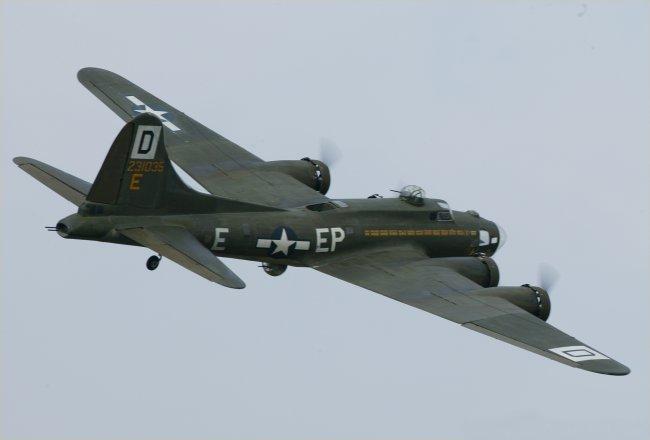
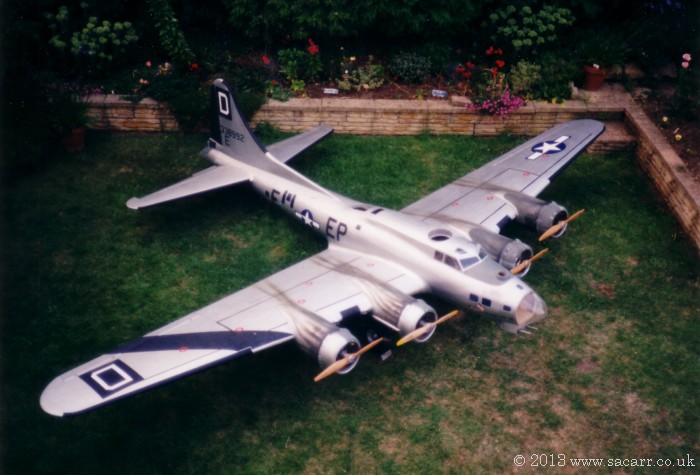
B-17G-BO-1 #42-31035 "Hang The Expense"

1/6 Scale Radio Controlled Model by Stephen A. Carr

Scratch Built to 1:6 scale
Length - 12 feet 4.5 inches
Take off Weight - 130 pounds
Wing Area - 39 sq ft
Engines - 2 x 3W-60cc & 2 x 3W-40cc Electronic ignition gasoline engines
Radio - Futaba FC-18 & Field Force 7
Fuel Capacity - 1 Gallon ( Imperial Gallon )
Retracts - Scratch Built Pneumatic Units with 9.5 inch diameter trailer jockey wheels
Propellers - Smart Wood 22 x 8 inch

Pilots - 2 ( pilot controls Ailerons, Elevators, Rudder & Inner Throttles; Co-Pilot controls the two outer independent throttles, Flaps and Landing Gear )

Build Time - 11 Months for silver finish to test fly airplane, then 6 months of detailing and repainting into olive drab after test flight.

Surface Finish - Z-Poxy and 1/2 ounce glass cloth, with full surface panel and rivet detail. Fabric control Surfaces.
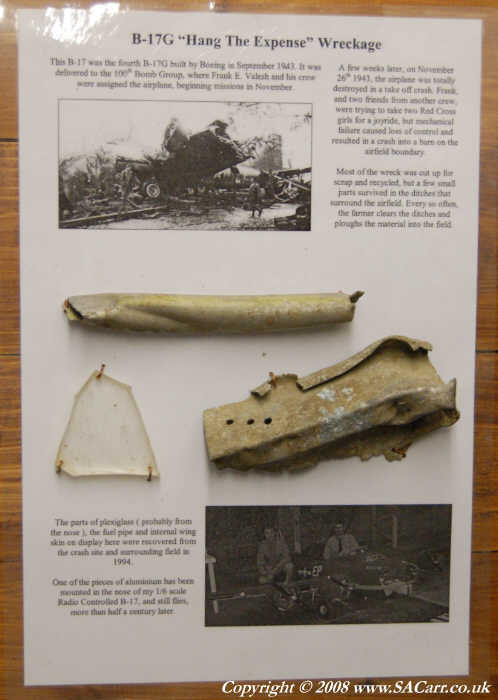
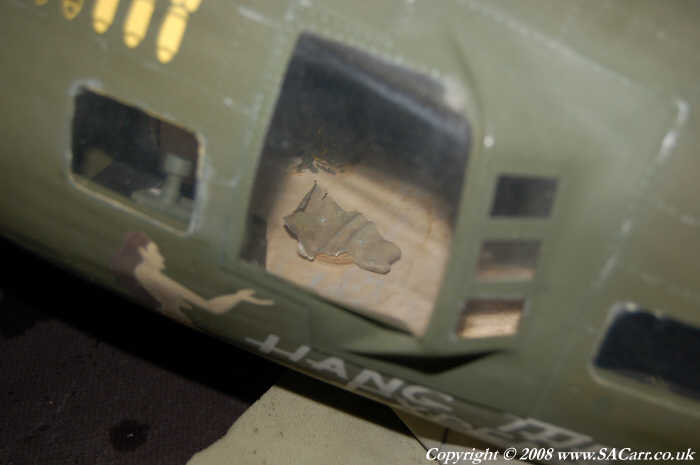
The Bombardiers compartment contains a piece of aluminum recovered from the crash site of the original airplane that flew with the 351st Bomb Squadron, 100th Bomb Group, based at Thorpe Abbotts in Norfolk, England in 1943.


CONSTRUCTION - September 1994 to August 1995
At the end of 1993, I scratch built a P-47D Thunderbolt to 1/6 scale so that I had a model to display at the UK model shows whatever the weather. Driving home from the show, I was chatting to a friend discussing how a 1/6 scale Fort, to match My P-47 and my friends P-51, would be nice.

By the end of the two hour journey, the decision was made. Wood cutting began two weeks later on what would become a record build for me...... a 17 feet wingspan bomber from design to flight in eleven months!!!!!

By the end of September/early October 1994, most of the fuselage structure and vertical stab was complete.

The inner wing panel therefore had a 39 inch root rib and a span of 50 inches. The flaps alone are 50 inches by 6 inches ( the size of a wing on many sports models ). The spars were 5/8 by 3/8 hard wood top and bottom in the scale positions, webbed be 1/16 ply. A laminate of 1/8 ply, 1/16 epoxy/glass sheet and 1/8 ply formed full depth front and rear tongues which entered the fuselage to bolt the the formers at each end of the bomb bay. A static 'G' test showed the spars and root joiners took a load of 9 'G' before I stopped loading them up.
Since there are many window in the B-17's cockpit, including the roof, the office needed to be filled out with detail, and with 39 sq feet of wing area to carry it all, weight shouldn't pose too much of a problem. Regardless of that, it gave me great personal satisfaction to reproduce the cockpit in miniature, right down to the Boeing logo in the control columns. 

The instrument was a colour photo while all the small details were made from pieces of styrene, acrylic or cast in resin. The seat buckets were vacuum formed over a wooded plug while the seat supports were soldered from brass tube.

Even the pilot and co-pilot were made, though they aren't fitted in this picture.

The B-17's structure is built in the same sub-assemblies as the fullsize airplane with the joints in the model at the scale break position. This picture, taken in late January 1995, shows ten of the sub-assemblies:- Forward and Rear fuselage, tail turret, left and right inner wing panels, left and right horizontal stab and the vertical stab.

With both of the outer wing panels complete, it was time for another photo. The garden was rapidly getting smaller. Up until this point, the B-17 had been sitting on bricks. It was time for some legs and wheels. Originally, they were operated by electric screwjacks, but later were converted to pneumatics

.

All the drag struts, torque links, etc, work as per fullsize. The torque links themselves were cast in aluminum into a plaster mould before final machining took place. It took a camping stove and a gas torch to get the ali hot enough to flow.
 

TEST FLIGHT - AUGUST 1995

Despite the B-17 parts being scattered across the grass, the parts were treated with great care during transport and assembly. This is a very physical task with the inner wings needed attaching with 12 bolts, accessed through the bomb bay, top turret and radio room hatch.

Assembling the model before I had the custom trailer took an hour! There were 10 major components to be connected electrically and mechanically. Then the props to add, each having six bolts.

After the range checks etc, the engines were started. Then came some taxi trials to see how the B-17 handled on the ground. OK - It's the day of the test flight. The range checks were fine, the taxi trials went ok, all is ready - except the wind which was across the runway.

Everyone asked me what we were going to do, and I said "Wait"

So we did. We sat there for a good 45 minutes before the wind slowly turned along the two mile long Elvington runway. ( I believe that this airfield in Yorkshire was an emergency landing ground for the Space Shuttle ).

So the time came, the tanks were topped up, the engines started, and the model wheeled to the runway.

The last engine run up checks were performed and everything was set to go. I opened the inner throttles and Andrew, the co-pilot, followed with the outer engines. The model tracked fairly straight due to the head wind against the huge fin.

After a ground roll of two to three hundred feet, the B-17 lifted off into a gentle right hand turn. I called "Gear Up", and Andrew hit the switch. Slowly the motors wound up the wheels.

The gear tucked away in the first turn and a little trimming was needed, but not much. As I leveled out into wind on the first circuit, one of the crew shouted "Heli, break right"

A fullsize RAF Search and Rescue Sea-King came low over the field at about 100 feet, straight for the B-17. I banked hard right and he saw me, pulled the chopper up on its tail, stall turned ( or what ever helis do ) and headed away.

The next 10 minutes went without problems flying figure 8 circuits, asymmetric and stall tests.

Time to land. Gear was called down on the up wind leg and 1/3 flap in the first turn. Power was reduced and 2/3 flap on the down wind leg. Power was reduced further and full flap called in the last turn lining up with the runway. The touchdown was perfect but for a slight skip.

The engines were shut down, and the model retrieved with smiles all round.

PAGE 2